
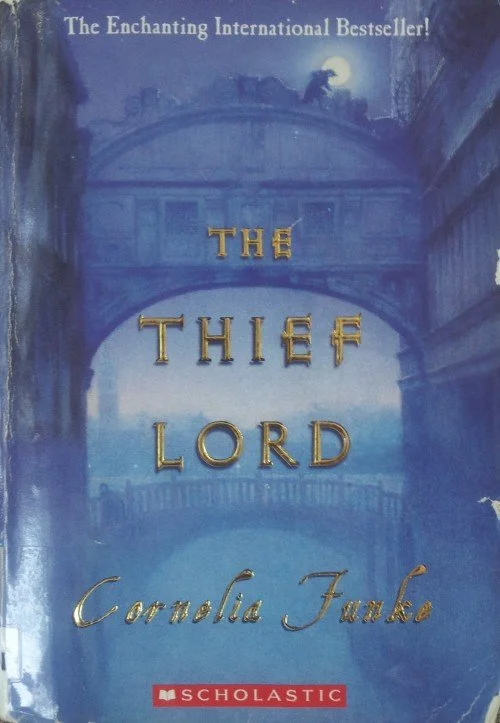
The Thief Lord by Cornelia Funke
Originally published 2000, translated into English 2002
Originally published in 2018 on my now defunct Tumblr blog, edited for copy quality and accuracy in 2026.
This was one of my favorite books as a preteen, and it has a LOT of food in it. The children living in the abandoned movie theatre obsess over and dream about pastry shops, sausages, olives, and anything else they can find or steal. I was totally obsessed with the idea of living in an abandoned theatre and sneaking around ancient carousels and statue gardens at night - it sounded so romantic and interesting. Adult me would beg to differ, which is somewhat ironically exactly in line with the plot themes about childhood vs adulthood viewpoints.
The food in the Thief Lord is memorable but less than authentic, and that is because this is a book written by a German native, about food in Italy. A lot of you might know this author from Inkheart, but this was my first book by her and, I think, my only English-language copy of her work in my personal library. I’d like to compare with a German-language copy before I really criticize her worldbuilding, but it’s abundantly clear throughout the book that despite having an otherwise strong sense of setting she doesn’t really seem to know what people eat in Venice. (Hint: it’s not pizza and spaghetti for every single meal.) I couldn’t find too many interviews or articles on Google where she mentioned her writing process, so if anyone has those I’d love a link, as I’m curious if she did end up going to the locations she wrote about.
Riccio, especially, eats a lot of sweets in this book, but the types aren’t ever mentioned. (They could be galani, since they’re powdered sugar dusted.) For some really nice writing on pastries and Venetian food in general I’d recommend Valeria Necchio, Skye McAlpine, Emiko Davies, or really just the original Artusi cookbook. (If you’re a savvy internet sleuth and you can’t swing a hard-to-find English copy, an Artusi pdf is easy enough to find, but I won’t say where or how.) In general I’d recommend reading Artusi if you like Italian food history though, just because it’s so genuinely good.
Chapter 2: Three Children
fish and dried mushrooms
little cakes
a handful of candy
coffee and sweet pastries
Chapter 6: A Nasty Coincidence
A box of chocolate filled cakes covered in powdered sugar, packed neatly and tied up with a ribbon
A slice of pizza
Chapter 7: Bad Luck for Victor
Spaghetti and fried sausages
Chapter 8: Scipio’s Answer
Leftover chocolate filled cakes
Olives, bread, pepper-red salami, and a bag of mandorlotti
Grape juice in goblets
Chapter 11: Victor Waits
Espresso, black, with three cubes of sugar
Chapter 15: A Beating for Victor
Pastries in the window of a paticceria
Chapter 17: Victor’s Trace
Chewing gum
Chapter 21: Baffled
Fresh bread and coffee
Chapter 22: The Casa Spavento
Apples and cabbages in a grocery bag
Chapter 27: An Old Story
Coffee with sugar
Glasses of juice
Chapter 30: Hopeless Lies
A cup of black coffee
Chapter 31: No Bo
Two mugs of hot milk and honey
Chapter 37: The Orphanage
Lunch at the orphanage
Mosca’s spaghetti with too much salt and burnt sauce
Chapter 39: All Lost
“Lucia the housekeeper had cooked, fried, and baked all afternoon. She had whipped cream, scooped tiny cakes from the baking tin, made ravioli, and stirred sauces.”
A glass of grappa
Coffee
Chapter 47: Strange Visitors
Fresh pasta dough
Chapter 48: A Crazy Idea
“a fantastic amount of spaghetti”
stolen chocolates
olives
ice cream and pasta
Chapter 50: The Bait
large helpings of ice cream
Chapter 51: Esther
Sundaes
Chocolate ice cream
A giant ice cream cone
Chapter 52: Everything Will Work Out Fine - or Will It?
A mint
Breakfast with Ida
