
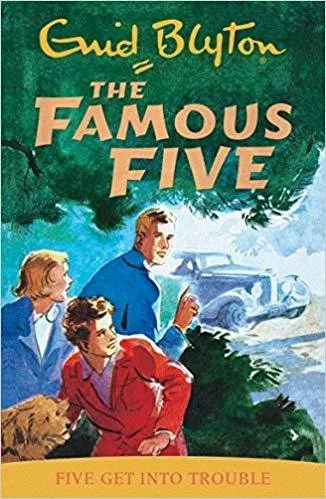
#8 Five Get Into Trouble by Enid Blyton
Originally published 1949 - not clear which version this was, as I used an ebook at the time
This post was originally published on my now defunct Tumblr blog in 2018, but I’ve copy edited it a bit and checked some sources to bring it up to current quality a bit more.
I was going to dive straight into Narnia, but I have so much more to say about those than I expected - and it’s summer. So let’s all take a little mental vacation with the Famous Five series!
First, I think it’s helpful to give a little bit of a background on these, since I think I might be in the minority for my age group in regards to having read them as a child.
The Famous Five series is a 21-book series about four children and their dog who are close friends/siblings and tend to end up on adventures. There’s Nancy Drew levels of improbable coincidences and frequent kidnappings, and tons upon tons of food descriptions. Enid Blyton loves adding sensory details in general (her series Malory Towers is similarly vivid) but the Five books are at times almost more food focused than plot focused. And surprisingly, they mostly hold up to an adult reader in the 2020s. There’s a lot of content that we would correctly find offensive now, unfortunately, but it’s par for the course for the publishing time period.
The book begins with another reason for the five to go off on their own without parental supervision, naturally. The children decide go on a bike trip and meet a sheltered, spoiled rich kid named Richard (yes, really) who is incredibly lonely and not allowed to go off on his own. So he of course runs away, and ends up getting everyone else kidnapped when some men harassing his father realize he’s unsupervised. They escape in the end and don’t really come to any serious harm, because of course this is a Five Finders Out book and these children are essentially impervious to damage, regardless of any plot contrivances.
The interesting part about this book, though, is that George, Anne, Julian and Dick go to shops to purchase food, rather than having it made at home for them. That means that luckily for us, the book lists what one would expect to be able to purchase ready-made from a village store in Dorset in 1949.
A few notes: When Blyton refers to “new bread” or “new rolls”, it’s similar to other books from this period that we’ve covered that clarify whether the bread was “new made” or not. New-made bread is a treat, especially for a group of kids heading out on an adventure, as it would’ve been fresh out of the oven just that morning. It’s not just that it’s describing the freshness of the bread, but it’s intended as a tone and quality signifier to let the reader know that this is a special meal for a special occasion.
It also should be noted that when the Five books mention ices or ice creams, they generally don’t specify a flavor or brand - Derek Oddy states in From Plain Fare to Fusion Food: British Diet from the 1890s to the 1990s that Britain generally lacked choices in convenience food during the late 40s and early 50s, due to rationing ending later than in the US. Ergo, less options. (Maybe no real options, for rural towns around Dorset..) So until otherwise stated I’m assuming that they’re ordering milk ice, as that’s mentioned frequently in other Enid Blyton books of the same period.
I’ve included longer passages when appropriate, as in this series I feel that the description is an important part of the foods listed.
Chapter 2
“The little shop sold lemonade, orangeade, lime juice, grape-fruit juice and ginger-beer. It was really difficult to choose which to have. it also sold ice-creams, and soon the children were sitting drinking ginger-beer and lime-juice mixed, and eating delicious ices.
“Think what a cow misses - never tastes an egg and lettuce sandwich, never eats a chocolate eclair, never has a boiled egg - and can’t even drink a glass of ginger-beer! Poor cows!” George laughed. “You do think of silly things, Anne,” she said. “now you’ve made me want my lunch all the more - talking about egg sandwiches and ginger-beer! I know Mother made us egg sandwiches - and sardine ones too.””
Chapter 3
“New rolls, anchovy paste, a big round jam-tart in a cardboard box, oranges, lime-juice, a fat lettuce and some ham sandwiches - it seemed a very nice assortment indeed.”
Chapter 5
“New bread, farm-house butter, cream cheese, crisp lettuce, fat red radishes and a bunch of spring onions. Richard bought a magnificent chocolate cake he saw in a first-class cake-shop.”
Lime juice and ginger beer
“Three big plates of well-buttered slices of bread, apricot jam, raspberry and strawberry, and a selection of homemade buns.”
Ginger cake
Chapter 7
Plain bread and butter, hardboiled eggs and milk and a bit of ham.
Chapter 9
A hard boiled egg
Leftover bread ham and eggs
Chapter 12
Bread and butter and jam, with some hot coffee to drink.
Chapter 13
Bread and butter and some boiled eggs and a jug of steaming hot cocoa
Chapter 16
Bread and cheese
Chapter 17
“A pie with delicious looking pastry on top, and a collection of buns, biscuits and oranges. There were also some home-made sweets.”
“Aggie had left about two dozen potted-meat sandwiches, a big slab of cherry cake and a bottle of milk.”
Chapter 18
Plum pie
