
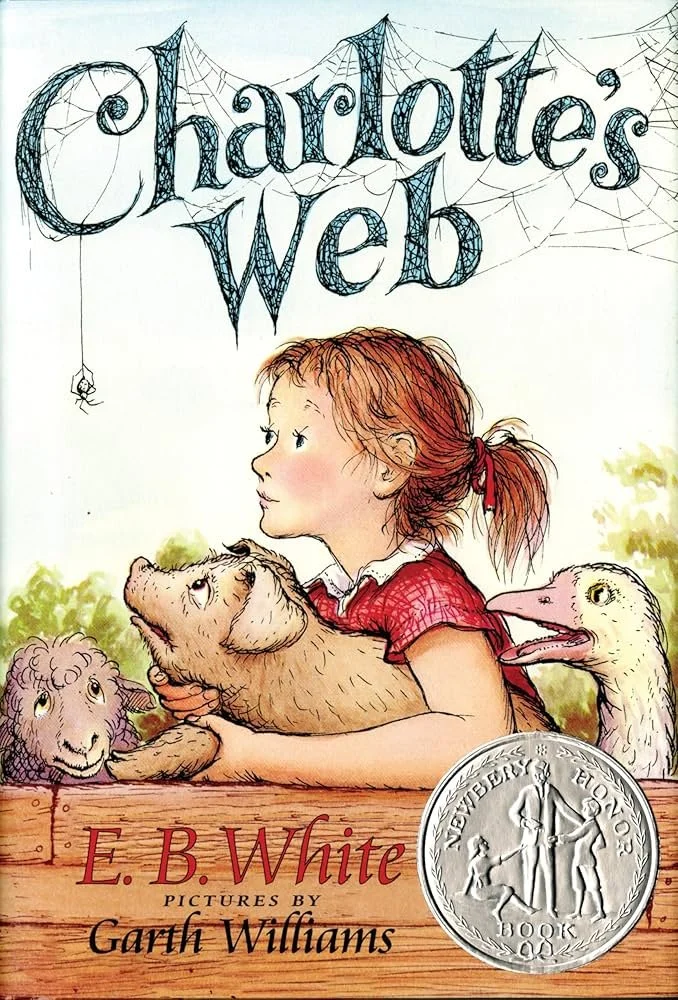
Charlotte’s Web by E.B. White
Published in 1952 - I believe the version I have is from the 80s, but text seems to be unaltered to my knowledge.
To briefly get personal - I originally did most of the reading and research of this book in late spring 2020, which is a very strange time to me to recall, not just because of the actual pandemic, but because I was dealing with long covid and a very long, blurry feeling recovery from being sick in March 2020 long before we knew what to do about it. I have virtually no memory of rereading this or writing the notes I found on this in my phone, which is especially strange for me because I have a near-photographic memory of nearly everything else that has happened in my life. My best guess is that I was so sick at the time for such a traumatically long period of time that I physically cannot remember it, but it’s still very weird to read fairly detailed, opinionated notes that I have no memory of.
Moving on.
At the time, I had been apparently reading this in an attempt to read more comfort books in the evening, as my insomnia was bad and I was still coughing quite a bit. I first read it in elementary school, but had not thought about it until I saw a tattoo piece from another artist I knew.
Fern, the main (ish) human character, is extremely interested in animal rights and her father, a farmer, makes a joking comment about Fern “wanting to rid the world of injustice”. At face value this seems like a pretty invalidating comment, especially because Fern only has so much power as a child in 1950s America. It however is a true comment, because Fern immediately gets distracted and forgets about her animals the moment a boy her age shows up. She cares about animals but in a superficial way - she doesn’t actually care about their physical needs or long term well being, she cares about the animal loving her back unconditionally. She abandons Wilbur at the most important moment with seemingly almost no remorse, and the book hand waves this away as “growing up”. Something about the tone of this and the way the book comments on her bothered me, somehow, to be honest. It kind of reminds me of the “problem of Susan” as written by C.S. Lewis - the book values childhood more than adulthood, but instead of criticizing Fern’s shift in ethics, it takes the opportunity to comment on the physical and social aspects of her becoming an teen and then adult woman. It’s offputting at best to read as an adult and it makes me wonder how much of it I noticed, if I noticed it at all, as a child.
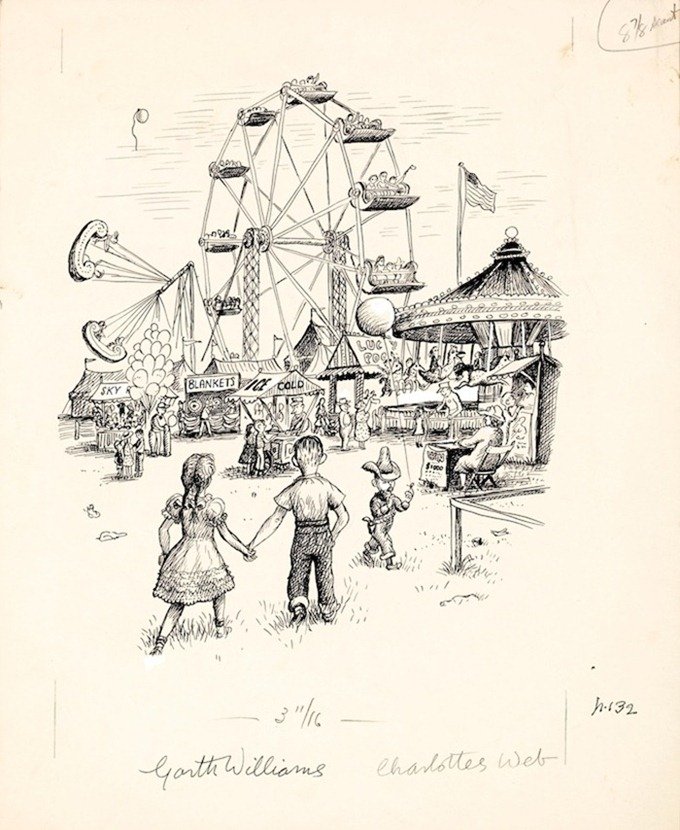
Fern’s family goes to the fair
(I never noticed how strange it was that they’re selling blankets, until I sourced this.)
Additionally, Fern can…. understand animals? As far as I can tell in the text, this is fully accepted and unquestioned. My original note on this just says “super weird that she can do that,” which is more or less 2026 me’s take as well. Not sure what else to say on this other than it’s a bit weird, based on how adamant the book is that nothing magical whatsoever is going on.
Another part that was interesting to revisit as an adult was the chapter where Mrs. Zuckerman has a nightmare about a deep freeze on the farm. I didn’t grow up in a farming household, so I didn’t have any kind of reference for how anxiety inducing that would be. Reading that passage now that I have a home farm of my own, however, and especially reading it during 2020 when I was heavily dependent on my own crops for fresh food, was horrifyingly relatable.
Overall, obviously a light read - it’s literally a book for children, of course. But it had some interesting layers that I didn’t expect to find.
The food is also, similarly, extremely comprehensively included, and was a joy to read. Charlotte’s Web was written at the tail end of a period of children’s literature that preceded convenience food and food industrialization being as common as it is now, and thus food was more likely to be homemade. I mention this not to have any sort of value judgement on industrialized food - I am actually in favor of food safety and industrialization, and I do not think being a chef or interested in food history is in conflict with that. But it does create a specific set of circumstances for the author to be including some very, very detailed food writing, and some really beautiful descriptions of what kind of food is available at Fern’s family farm.
The style reminds me of Enid Blyton, which I’ll probably go back to reviewing here as well, because her books are delightfully unhinged. (Why are these children solving a murder? Why are these children constantly in such convincing disguises? Why do their parents let them go on 3-4 day bike trips alone? Surreal fare even for the era.) But that comparison is high praise from me, to be clear. Enid Blyton and the other authors of her era are partially what inspired me to start this blog, because the food descriptions are so memorably lovely. Extremely problematic as books, to be clear, but also well written.,
On to the food. As usual, I’ve linked recipes for anything that isn’t immediately obvious or a brand name food available in 2026.
A pitcher of cream
Coffee, bacon, donuts (to go)
Pig slop: warm milk, potato skins, wheat middlings*, Kellogg's Corn Flakes, and a popover left from the Zuckermans' breakfast.
Skim milk, crusts, middlings, bits of doughnuts, wheat cakes with drops of maple syrup sticking to them, potato skins, leftover custard pudding with raisins**, and bits of Shredded Wheat.
Middlings, warm water, apple parings, meat gravy, carrot scrapings, meat scraps, stale hominy***, and the wrapper off a package of cheese.
Skim milk, provender****, leftover sandwich***** from Lurvy's lunchbox, prune skins, a morsel of this, a bit of that, fried potatoes, marmalade drippings, a little more of this, a little more of that, a piece of baked apple, a scrap of upsidedown cake******.
“In early summer there are plenty of things for a child to eat and drink and suck and chew. Dandelion stems are full of milk, clover heads are loaded with nectar, the Frigidaire is full of ice-cold drinks.”
Smoked bacon and ham
Beechnuts and truffles
A piece of blueberry pie
Wild raspberries
“It was a delicious meal - skim milk, wheat middlings, leftover pancakes, half a doughnut, the rind of a summer squash, two pieces of stale toast, a third of a gingersnap, a fish tail, one orange peel, several noodles from a noodle soup, the scum off a cup of cocoa, an ancient jelly roll, a strip of paper from the lining of the garbage pail, and a spoonful of raspberry jello.”
“The blackberries got ripe, and Mrs. Zuckerman failed to put up any blackberry jam”
A buttermilk bath
“In the trampled grass of the infield you will find old discarded lunch boxes containing the foul remains of peanut butter sandwiches, hard-boiled eggs, cracker crumbs, bits of doughnuts, and particles of cheese. In the hard-packed dirt of the midway, after the glaring lights are out and the people have gone home to bed, you will find a veritable treasure of popcorn fragments, frozen custard dribblings, candied apples abandoned by tired children, sugar fluff crystals, salted almonds, popsicles, partially gnawed ice cream cones, and the wooden sticks of lollypops.”
Candied Apple
Hamburgers frying
a frozen custard and a cheeseburger and some raspberry soda pop*******
Lunch boxes
leftovers from somebody's lunch: a deviled ham sandwich, a piece of Swiss cheese, part of a hard-boiled egg, and the core of a wormy apple.
A dish of canned peaches
Red little apples
*Wheat middlings would have been specifically something the pigs would be eating on a farm in this era, since they’re made with the parts of the flour that aren’t finely milled or high quality enough to be made into bread or sold. It wouldn’t have made economical sense for them to throw out edible flour just because parts of it aren’t cosmetically desirable, so it would have gone into the pig troughs. From what I can find from modern millers, they’re actually very good, and similar to cream of wheat, even for human beings.
**There were a couple options here that I could have gone with, but the inclusion of Shredded Wheat cereal had me thinking it was likely this depression-era recipe. It was only printed about 15 years earlier, so it’s plausible to me that Fern’s mother likely would have seen it while learning to cook.
***The recipes from cookbooks in this era don’t actually have a lot of specific recipes for hominy, just ratios of water and weight for cooking. I imagine, like rice, they just kind of assumed you would know to season or flavor it to your own preference, if you had it. Use your imagination here, I assume based on the era however that they’re just using butter and salt.
****Livestock feed. I’m guessing this is poetic license too, given that most era-appropriate sources use provender to refer to fine dining or cultural foods and it wasn’t a super common usage.
*****I can’t specifically prove it was wartime level sandwich fillings, but given the other recipes mentioned and given that a lot of middle America was still evidently loving potted meat sandwiches all the way into the mid 60s if Nancy Drew is any indication, I’m going to assume they were still popular. I’m also including this era-appropriate menu for reference on what the options would’ve been like. I will say, as someone who has been to Maine (and no offense to Maine, I loved it), their food culture seems to tend to hang on to older recipes moreso than other areas, so this would check out to me as well.
******Upside down cake, surprisingly again to me as a modern reader, was not just pineapple specific in the 40s and 50s. Since again Fern’s household farms their own produce, it’s entirely possible they could’ve been making this apricot version.
*******I went on a wild rabbit hole with this one and ended up reading many, many Facebook posts to try and track down what the author might’ve intended. If it weren’t in such a rural area I’d assume they got soda from a fountain and it was custom mixed - but the key is knowing where E.B. White is from, and what the food was based on. Batchelor’s Better Beverages from Rhode Island owned by Cosmo Mazzarella produced a raspberry, as well as a strawberry soda, and was largely New England-specific. It’s very difficult to find information on them now, but it looks like they were very popular at the time and produced soda from the mid 1920s to at least the 1980s, possibly even the mid-1990s based on some residents’ recollections. Miscoe Soda, a competitor, was also a likely option - they offered blackberry, birch beer, and black cherry, as well as raspberry. Without more description about the packaging, and just a flavor to go on, it’s really hard to tell. It’s pretty likely to be a regional soda brand, however - based on the research I did on people’s personal recollections and the guides I could find on internet archive and google books, a lot of them were making berry specific flavors for the New England market. I considered Nehi as an option solely given the widespread popularity but I couldn’t find any evidence of a raspberry flavor whatsoever. One thing I know it’s not, though, is Moxie - I feel like I might be one of the only people who genuinely enjoys Moxie who isn’t a Maine native, haha.
